Ananta is not infinity. Not exactly.
Infinity in mathematics is a horizon we calculate toward. In Vedānta it is the end of dependence.
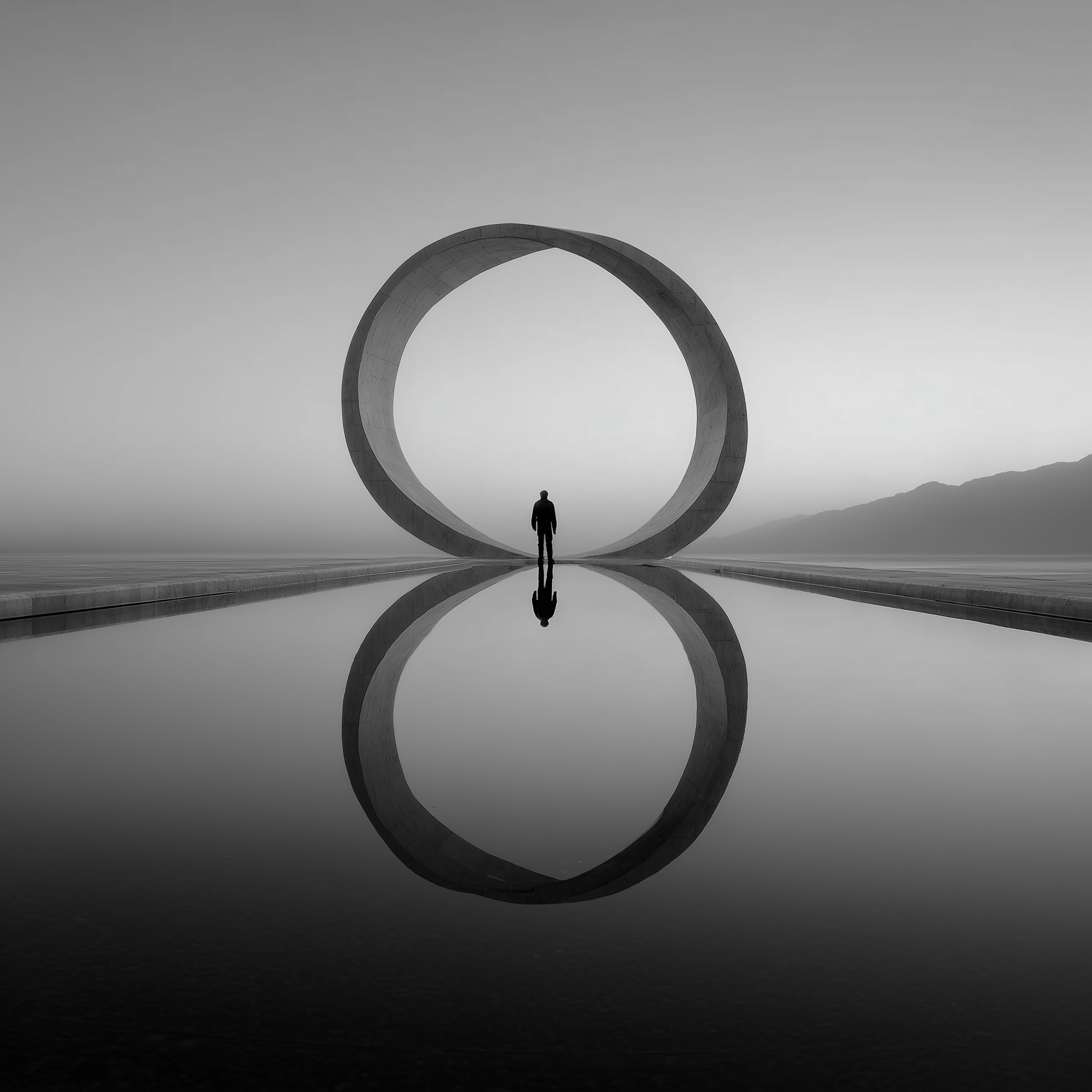
We reach for it the way we reach for a clean whiteboard. It gives us room. It rescues our equations from awkward edges. It lets us say “forever” without specifying what we mean by time, space, or possibility. Infinity becomes a permission slip: if the world is infinite, we don’t have to explain its walls.
But the longer I’ve lived inside actual things—chemicals in a flask, molecules in motion, people in habit—the less I see infinity living anywhere outside our notation. I see abundance. I see complexity that defeats intuition. I see systems that keep surprising us. What I don’t see is a world that behaves as though it has no boundaries.
The confusion begins early because our best tools lean on infinities. Calculus leans on limits. Quantum mechanics leans on wavefunctions that never quite die. Field theory leans on continua that flow smoothly across space-time. Take the mathematics literally and reality looks like an endless canvas. It’s tempting to treat that canvas as proof of something ultimate.
Chemistry is where the temptation first feels honest. Take two reagents. Let them meet. You don’t get everything. You get a small family of products constrained by structure and energetics. Even complicated mixtures don’t generate wildness without rules. Generalize that and you arrive at a reassuring picture: the world is built from a limited stock of primitives—elements, laws, guṇas , tattvas —and everything we ever see is a rearrangement of that stock. The phenomenal world begins to feel countable.
The trouble is: that picture flatters us.
A finite alphabet can write an infinite library if you let sentences grow without limit. A small set of monomers can generate polymers without a natural ceiling on length. A reaction network can keep producing new intermediates as long as there is energy and room to keep running. And the moment you allow continuous variables—position, momentum, field amplitude—the counting game collapses. Between zero and one there are uncountably many values.
So if the goal is to evict infinity from nature, you can’t do it by counting building blocks. Finite ingredients don’t guarantee finite outcomes. That isn’t philosophy. It’s arithmetic wishful thinking.
The real question is harsher and cleaner: not what the universe is made of, but what it can hold. How much information can be instantiated.
This is where modern physics—when you listen to it as restraint rather than spectacle—starts to sound unexpectedly close to Vedāntic sobriety.
Every measurement yields finite information. Every apparatus has finite resolution. Every signal comes with noise. Nature behaves like it charges rent for detail. You can write a continuum on paper, but you can’t extract infinite digits from a physical process. There is always a cutoff: bandwidth, energy, time, stability. Infinity may be a brilliant tool in our models, but the world does not hand it to us as an object.
That distinction matters. It separates infinity as a method from infinity as a realized state-space. A theory can use continuity and still allow only a finite number of distinguishable configurations in any finite region, under real constraints. Infinity can remain an elegant horizon while physical reality behaves like an economy.
People reach for the hydrogen atom here. The electron’s wavefunction extends without a hard edge. It decays, but it never quite becomes zero. On paper that means there is some nonzero probability of finding the electron arbitrarily far away. It’s easy to laugh at this—like a tail we keep only because it makes the math behave.
But the laugh is wrong. The tail isn’t decoration. It does work. Tunneling—behind fusion in stars and the operation of semiconductors—lives exactly in those regions where classical intuition insists nothing should be happening. Cut off the tail because it feels “practically irrelevant,” and you cut off the mechanism.
The better lesson is simpler: we confuse “mathematically allowed reach” with “physically realized infinity.” The state may have reach. The world we actually observe still shows bounded outcomes, localized interactions, finite records. The formal object can sprawl across space, and yet the ways we learn anything remain finite. Possibility is vast. Actualization is selective.
Now bring Vedānta into the room and the word “infinite” has to change meaning.
Vedānta ’s ananta is not the mathematician’s infinity. It is not a claim about cardinality, or length, or the size of a set. It is a claim about delimitation.
Everything in the world arrives with edges. A thing is this and not that. Here and not there. Now and not then. It changes, so it can be absent. It depends on conditions, so it cannot stand by itself. The phenomenal world is not merely large. It is structured by limitation. To appear at all is to be carved out of the rest.
That is why Advaita calls the world mithyā : not nonexistent, but not self-sufficient. Real in experience, dependent in being. The world does not carry its own foundation inside itself.
And in that framework, Brahman is called “infinite” for a very specific reason: it is not another bounded item standing opposite other bounded items. It is not a cosmic object with an infinite warehouse. It is the ground in which all boundaries appear—the non-delimited reality not confined by space, time, or object. Infinity here means “not-limited,” not “more.” The Taittirīya declares: satyaṃ jñānam anantaṃ brahma— Brahman is truth, knowledge, infinite. That ananta is not a quantity. It is the absence of finitude.
Once you see that, the argument stops trying to bully Vedānta out of physics. Physics can’t do that. What it can do is sober us up: remind us that infinity is often a tool, that realized systems behave as if they have caps, that the world is not a free-for-all of boundless instantiation. Then Vedānta does its own work: it tells you what “infinite” means when it is said about reality instead of numbers.
This brings you, inevitably, to free will—because most free-will talk is really a demand for a kind of personal infinity.
When people say they want free will, they often mean a will that is unconditioned—unshaped by genetics, history, temperament, society, brain state, or laws of nature. They want a chooser outside the network. They want freedom without bounds.
It’s an understandable desire. It’s also a fantasy that sneaks omnipotence into the language of ethics.
In real life, choices are made inside constraints. You choose among available options with a mind that has a history, in a body that has limits, in a world that does not pause to grant you metaphysical exemption. That doesn’t make choice meaningless. It makes it human. It makes it the kind of agency that can be educated and disciplined, widened at the margins, and held responsible—because it isn’t magic.
Vedānta adds the crucial distinction modern arguments often miss. The machinery of choice—the mind, the antaḥkaraṇa —belongs to prakṛti . It is conditioned, lawful, patterned. The witness, Ātman , is not that machinery. The witness does not “choose” in the ego’s sense. Its freedom is not power over an infinite menu. Its freedom is not being trapped inside the identity of the chooser.
The ego wants freedom as power. Vedānta offers freedom as release.That exchange is hard to accept.
So yes, the world may be vast beyond any human scale. It may even be temporally without end, for all we know. It may be modeled as continuous at every scale we can probe. None of that grants it the kind of infinity people casually imagine. The world remains a domain of boundaries: bounded records, bounded resolution, bounded instantiation, bounded agency.
And that is exactly why the Vedāntic “infinite” is radical. It isn’t a bigger universe. It isn’t an endless supply of options. It’s the recognition of a reality not defined by edges at all.
Infinity in mathematics is a horizon we calculate toward. In physics it is often a convenience we use with discipline. In Vedānta it is the end of dependence.
The intellect uses infinity to avoid the wall. Vedānta uses it to show you the one place there isn’t one.
